Counting beads
Advance once after a complete mantra. Keep the same convention throughout a session. If you lose your place, resume from a known bead; follow your teacher’s approach for formal accumulations.
THE MALA MEDITATION BEADS GUIDE
A practical guide to 108 mala beads, the rhythm of mantra counting, and choosing materials with care.
Rooted in Tibetan Buddhist practice.
Welcoming to beginners.
01 / UNDERSTAND THE BEADS
A mala is a string of beads that keeps count while your attention stays with the mantra.
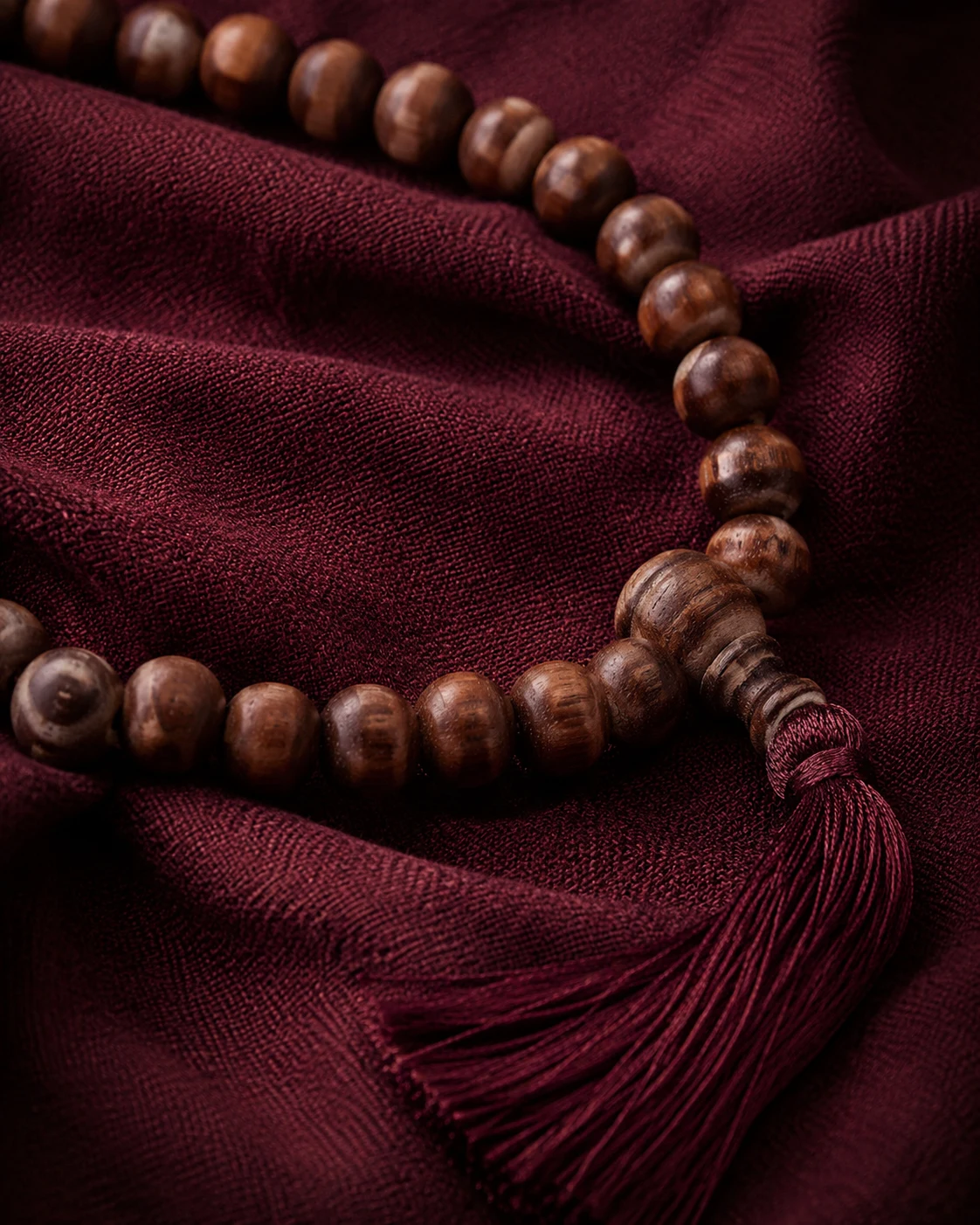
A full-length mala commonly has 108 counting beads and a separate, usually larger guru bead. Smaller malas can be used for shorter rounds. The word mālā means “garland.” [1]
There is no single explanation of 108 shared by every Buddhist tradition. One familiar interpretation relates it to 108 mental afflictions; the number serves as a reminder of the path of practice, not a guarantee of a particular result. [2]
You do not have to complete 108 repetitions at once. A few attentive recitations are a sensible place to begin.
1 round = 108 recitations
2 rounds = 108 recitations
4 rounds = 108 recitations
These are literal bead counts, excluding the guru bead. Wrist malas vary: count yours rather than assuming every bracelet has 27 beads.
Start on the bead beside it. A common custom is to reverse direction when you return, instead of passing over it. Marker or spacer beads may be extra or part of a design’s count; check how your mala was strung. [1]
02 / FIND YOUR RHYTHM
Choose one mantra. Move one bead after each complete recitation—not after every word or syllable.
Om Mani Padme Hum
MOVE ONE BEADThis is general guidance. Hand, finger, direction, and formal counting customs vary; follow your teacher’s instructions for your tradition. Method reference ↗
Sit comfortably, let your breathing be natural, and take a moment to cultivate kindness toward yourself and others.
Hold the first counting bead gently. A Tibetan method uses the left thumb to move beads over the index finger; this is not a universal rule. [1]
Say the whole mantra aloud, softly, or mentally, then advance. For a long mantra or dharani, the entire text is one repetition—not each line. Do not force your breathing to match it.
After the last counting bead, pause. To continue with the common reversing method, turn the mala and use that last bead as the first bead of your next round. [3]
Rest quietly for a few breaths. You may dedicate the practice to the well-being of others. The count supports attention; it does not need to become a race.
THE COUNTING MECHANISM
Beads track repetitions. Markers show your place. Separate counters record completed rounds.
Advance once after a complete mantra. Keep the same convention throughout a session. If you lose your place, resume from a known bead; follow your teacher’s approach for formal accumulations.
Distinctive beads may mark 27, 54, and 81 counting beads. They help you feel your progress. Do not automatically add decorative spacers to your recitation total. [4]
A common Tibetan arrangement has two strings of ten small beads. Use one for rounds and the other for groups of ten rounds; a movable clip can mark larger totals. Conventions vary. [2]
108 RECITED ≠ ALWAYS 108 RECORDED
Some Tibetan instructions record a full 108-bead round as 100, allowing the extra eight for mistakes. That is a practice convention, not a different bead count. Use the convention your teacher gives you, and do not mix the two systems in your notes. [5]
| What you track | Total |
|---|---|
| Literal recitations | 1,080 |
| 100-per-round convention | 1,000 |
Counter example: move one bead on the first string after each round. After ten rounds, reset that string and move one bead on the second. With the 100-per-round convention, that second-string bead records 1,000. Decide and note your system before beginning.
03 / CHOOSE WITH CARE
A useful mala does not need to be rare or expensive. Look for clearly identified materials, comfortable beads, and sound construction.
WOOD
Ask which wood species is used, where it came from, and whether fragrance, stain, or finish was added. “Sandalwood-style” describes a look—not proof of sandalwood.
SEEDS
“Bodhi seed” is not one botanical species. Researchers documented many plants sold under that name. Ask for the plant identity and whether a bead is natural, carved, or moulded. [6]
STONE
Ask whether the material is natural, treated, reconstructed, or an imitation. Genuine turquoise can be stabilised with resin or dyed; “natural stone” alone does not mean untreated. [7]
BONE & ALTERNATIVES
If considering bone, ask for the species and source. If avoiding animal materials, ask explicitly whether the beads are plant-based or synthetic; a bone-like colour is not enough to identify them.
Photos, colour, price, and marketing terms do not establish a bead’s identity. Request a written material description and a return policy; for a costly gemstone claim, consider independent gemological identification. An honestly described alternative can still serve your practice. This guide does not authenticate individual products.
Store your mala respectfully in a clean pouch and avoid soaking it. Check the cord for wear before it breaks. Follow care instructions for the specific material; do not use steam, ultrasonic cleaning, or solvents on turquoise. [1] [8]
Spiritual associations are part of religious tradition, not a promise that a bead material will treat illness or guarantee an outcome.
04 / BEGIN YOUR PRACTICE
Practise with recordings from Next Level Meditation. Move a bead for your own complete recitation, not every beat of the music.
Explore our YouTube channelCHENREZIG / AVALOKITESHVARA
Om Mani Padme Hum
One complete six-syllable mantra, then one bead. A simple place to start with a short round.
Watch on YouTubeGREEN TARA
Om Tare Tuttare Ture Soha
Follow the entire phrase before advancing. Keep your recitation comfortable and unhurried.
Watch on YouTubeGURU RINPOCHE / PADMASAMBHAVA
Om Ah Hum Vajra Guru Pema Siddhi Hum
The whole mantra counts as one repetition. Written forms and pronunciation vary by tradition.
Watch on YouTubeAVALOKITESHVARA / LONGER RECITATION
A longer text, a different rhythm
This is not the six-syllable Om Mani Padme Hum. Count one bead after the complete dharani.
Watch on YouTubeThese links open searches within our channel. Recordings support listening and recitation; they do not replace any empowerment, transmission, or instruction required for a formal Vajrayana practice.
Practice customs differ across traditions. The sources below support the counting, handling, and material-identification notes in this guide.
Educational guide by Next Level Meditation. No individual beads or sellers are certified by this website.